Nov 22, 2024 | Age & Dementia Friendly
Person-Centered Dementia Care: Understanding Behaviors and Effective Communication
Thursday, December 12, 2024
12:00-1:30 PM
Zoom
As people living with dementia progress in their journey, their ability to communicate also changes. Professionals must discover new ways to communicate effectively for all stages of the disease. Behavior is a powerful form of communication and is one of the primary ways for people with dementia to communicate their needs and feelings as the ability to use verbal communication diminishes. Join us to learn how dementia affects communication, how person-centered approaches can improve communication, how to decode behavioral messages, identify common behavior triggers, and learn strategies to help intervene with some of the most common behavioral challenges of Alzheimer’s disease.
Free CEUs for social workers and nurses
Nov 8, 2024 | Age & Dementia Friendly, News
The 2024 Dementia Friendly Massachusetts (DFM) survey results indicated a strong interest in learning about grant funding opportunities. Several responses also pointed to a lack of financial support being a barrier to growing DFM initiatives. Here are some grant programs and funders that might be a fit for your ideas (each title is a link):
Categories of SIG grants are subject to change, but the FY25 categories most relevant to DFM work were for Memory Cafés, Age-and Dementia-Friendly initiatives, and Caregiver Respite. The link takes you to an overview of the FY25 grant timeline (starting in spring 2024), which will be similar for FY26.
Point32Health Foundation has an equity in aging focus. It supports programs that acknowledge and seek to remedy systemic barriers to better health. If your program idea would help meet needs of high-risk people within your community of older adults, it might be eligible for support. Inquiry forms are accepted at any time.
Community Foundations in Massachusetts are regional nonprofits that span the state and have various means of doing philanthropic work in their communities, either by giving grants directly or directing donors to organizations and programs that they endorse. Find out about the one close to you: if they give grants, and if your program ideas might be eligible.
Berkshire Taconic Community Foundation
The Boston Foundation
Brookline Community Foundation
Cambridge Community Foundation
Cape Cod Foundation
Community Foundation of Nantucket
Community Foundation of North Central MA
Community Foundation of Western MA
Essex County Community Foundation
Foundation for MetroWest
Greater Lowell Community Foundation
Greater Worcester Community Foundation
Martha’s Vineyard Community Foundation
South Coast Community Foundation
Watertown Community Foundation
LCC funds could support musicians and artists featured at Memory Cafés! Every municipality has an LCC that distributes MA Cultural Council money. Usually COAs partner with an artist who will write the grant and be the direct recipient of funds.
Providing small grants ($1,000-$20,000) to nonprofits and government entities for a broad array of programs or operating support. November 12 is the next deadline. Learn more on their FAQ page; they have not defined specific funding priorities.
We are keeping a growing list of these on the DFM website’s Resources page.
Oct 17, 2024 | Age & Dementia Friendly, News, Public Health
We all know what it’s like to be mired in the day-to-day demands that make it increasingly hard to see the forest for the trees and to maintain the vitality of our connection to the meaning of our work.
But there are unique ideas and programs aiming to improve how we build a society that is livable for older adults that are brilliantly worthy of our attention. They encourage us to slow down and take the time to grow our compassion through the extraordinary experiences of others.
A couple programs of this nature came to my attention in the past week: Gold Coats and the living experiment that inspired the Human Forever documentary film (2024).
 Gold Coats
The Gold Coat program, based at the California Men’s Colony State Prison in San Luis Obispo, trains inmates to provide a high standard of care for their fellow inmates who are living with dementia and other cognitive disorders. Testimony from the Gold Coats provides extremely moving insight about the power of caring for others in the most trying circumstances.
Human Forever
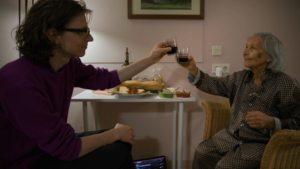 Teun Toebes, a 25-year-old Dutch nursing student and now an international spokesperson on dementia and healthcare innovation, lived in a closed ward memory care unit in a Dutch nursing home for three years. He wrote a book about that experience and then toured the world with independent filmmaker Jonathan de Jong to learn about international models of care and to create the film Human Forever (2024).
Teun Toebes’ book about his experiences: The Housemates: Everything One Young Student Learnt about Love, Care and Dementia from Living in a Nursing Home
Go ahead—give yourself permission to learn a little bit about creative and innovative ways to provide care and special experiences for people living with dementia.
Jul 19, 2024 | Age & Dementia Friendly, Housing, News

The mic-drop moment at the July 11 Outreach meeting was when the presenter, Tim O’Reilly, who manages building projects for Backyard ADUs, shared that Massachusetts’ Home Modification Loan Program (HMLP) will provide 0% interest loans of up to $50K to eligible households for the building of accessory dwelling units.
Older or disabled adults who are interested in making changes to their homes to increase their long-term, at-home independence, may apply to the program.
Additionally, household members who are not disabled or over 60 can submit applications for home modifications or the creation of accessory dwelling units (free-standing or in the existing home) that will aid older adults or people with disabilities in their households.
Distinct from a home repair program, HMLP provides loans that support projects that may include: ramp and lifts, bathroom and kitchen adaptations, sensory integration spaces, fencing, and, as noted, accessory dwelling units. It’s all about increasing accessibility.
The HMLP is administered for the state by the Community Economic Development Assistance Corporation (CEDAC), which in turn has delegated the processing of applications to regional agencies. For a list of regional provider agencies and eligibility and application information, see the program brochure.
More general information on the program can be found on CEDAC’s HMLP webpage.
2023 Income Limits
| Household size |
Maximum Annual Income |
| 1 |
$207,800 |
| 2 |
$237,600 |
| 3 |
$267,200 |
| 4 |
$296,800 |
| 5 |
$320,600 |
| 6 |
$344,400 |
| 7 |
$368,200 |
| 8 |
$391,800 |
Apr 29, 2024 | Age & Dementia Friendly, Events
The next meeting will be held on Wednesday, May 8th. The session will be held at 1:00 pm. The meeting will feature Norwell COA Director Susan Curtin who will discuss the new Norwell Memory Café and the SE Regional DF Facebook page. https://www.facebook.com/groups/southshoredementiaresources.
In addition, Swampscott COA Director Heidi Whear will talk about the newly launched “Swampscott for All Ages Forget Me Not Initiative.” The “Forget Me Not Initiative” was officially kicked off at Café Avellino where staff have been trained to support people living with dementia. https://itemlive.com/2024/04/23/an-event-not-to-be-forgotten-in-swampscott/
You can register here.